
REFLECTIONS ON A RECOGNITION
By Judge Lino S. Lipinsky de Orlov
Colorado Court of Appeals
When the Denver Bar Association honored me with its 2025 judicial excellence award, I reflected on how that honor represented the culmination of decades of involvement with our legal community and dedication to pro bono representation.
When she presented me with the award, Colorado Bar Association President Catherine Chan noted not only my position on the Colorado Court of Appeals, but also my membership on the Access to Justice Commission and, with Justice Maria Berkenkotter, my articles and speaking engagements on the intersection of artificial intelligence (AI) and access to justice.
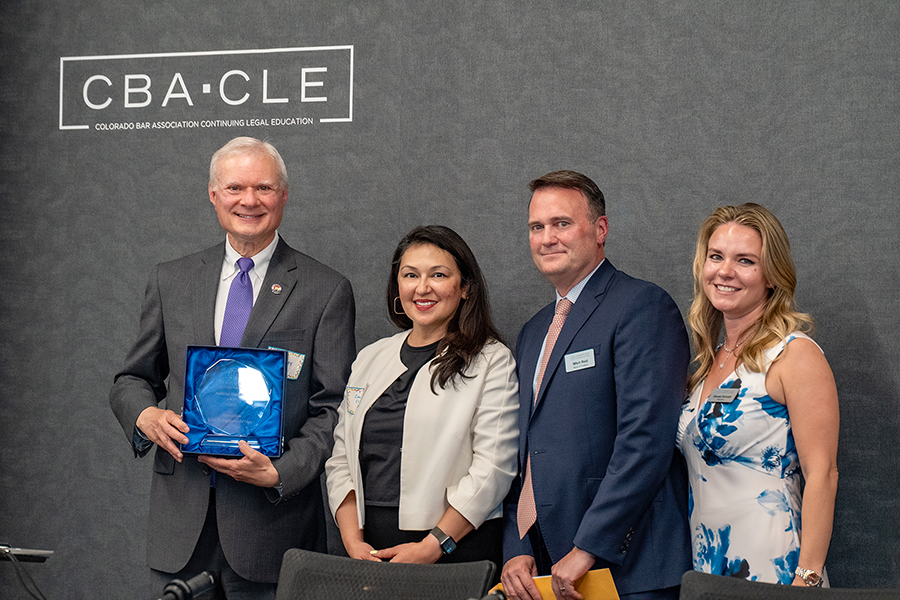
Photo by Natalie Hustead. Hon. Lino Lipinsky de Orlov, Catherine Chan, Mitch Reid, and Danae Kinnett
I did not develop these interests only after joining the bench; rather, they built on the pro bono matters I handled in private practice, the support I received from the Denver and Colorado Bar Associations throughout my career, and my longtime fascination with legal technology.
From our first days as lawyers, my wife and I committed ourselves to providing pro bono representation for members of our community who could not afford a lawyer. My first Denver firm, with support and training from the DBA’s Thursday Night Bar program, encouraged associates to represent indigent individuals in dissolution of marriage cases.
Some of my first court appearances as a rookie lawyer involved advocacy for modest means clients in family law matters. I recall the real-life lesson I learned when, as a first-year associate, I won a significant child support award for a client — an indigent single mother in her early twenties with three young children — only to discover that the children’s father, who had worked construction jobs in this state for cash, had vanished from Colorado without a trace. But I was able to obtain for other pro bono clients the financial resources they desperately needed to pay for their children’s food, clothing, and medical care. At the same time, my wife was handling pro bono matters for homeless advocates, including a community leader who faced criminal charges for permitting an unhoused family to shelter in a vacant repossessed home.
My wife and I realized these cases could be more rewarding than our matters for paying clients.
Three of my pro bono cases stand out for me. First, I represented a young Denver employee who had requested three days of sick leave to care for her grievously injured same-sex domestic partner. The city denied my client’s request because, at the time, domestic partners were not included in the Denver Career Service Authority’s definition of “immediate family” members for whom city workers could take sick leave to care for. The employee could not afford a lawyer, and I agreed to represent her without charge.
I argued to a hearing officer that my client’s domestic partner was an “immediate family” member under the plain language of the city’s sick leave policy and that my client should not have been penalized for using her own earned sick leave to remain at her partner’s bedside.
Although I won the case before the hearing officer and, later, a Denver District Court Judge, ironically, the Colorado Court of Appeals reversed. The division concluded that my client had been discriminated against based on her marital status — conduct that, at the time, the city rules permitted.
But there was a happy ending. Although I could not convince the Court of Appeals that the Authority had engaged in illegal discrimination under the city rules, the city eventually changed its definition of “immediate family” to expressly encompass life partners. After the Supreme Court held that marriage equality was the law of the land, my client married her partner. They are now parents of two grown daughters who share their parents’ dedication to justice.
Second, with co-counsel, I filed a lawsuit to challenge the Denver Police Department’s maintenance of secret dossiers — “spy files,” according to the local press — on peaceful activists. Through flawed gang-monitoring software, the Police Department had linked our pacifist clients with violent counter-protestors merely because the latter had appeared at the same public events as the former. Following months of litigation, we negotiated a settlement that included, among other provisions, the appointment of an independent monitor — former Court of Appeals Judge Steve Briggs — to ensure the Police Department would respect the First Amendment rights of peaceful protesters. (The “spy files” are now housed at the Denver Public Library’s Special Collection and Archives Department.)
Third, through the U.S. District Court’s Pro Bono Panel initiative (which Natalie Hanlon-Leh and I helped to develop when we were officers of the Faculty of Federal Advocates), an associate at my then-firm and I represented an indigent mother whose former husband had moved to Canada with his new wife and relocated my client’s young daughter to that country, in violation of the final orders in the parties’ dissolution of marriage case. The mother, representing herself, sued her ex-husband in federal court under the International Child Abduction Remedies Act (ICARA) to recover her child. She soon discovered the difficulty of self-representation, especially when the adverse party possesses the financial resources to hire an aggressive attorney.
The federal district court judge assigned to the case was concerned that the mother had a potentially meritorious case but was not effectively representing herself. He called to tell me he was appointing me as the mother’s pro bono counsel. I suggested that the judge instead appoint a lawyer with family law experience and admitted I knew nothing about ICARA. The judge said, “that makes two of us,” and added, “I am confident that you can learn the statute.”
With our assistance, our client prevailed at a critical hearing, after which we negotiated a favorable settlement. Her ex-husband agreed to return the child to her mother and to spend his future parenting time in Colorado. Our client expressed her deep gratitude for our assistance in bringing her daughter back home.
“John and I knew that, without a robust internet connection, many low-income individuals in our state could not easily confer with a lawyer…”
In addition to these cases, nearly every month, I volunteered at the Colorado Lawyers Committee’s Legal Nights, where volunteer lawyers help low-income individuals find pro bono counsel. I was able to assist many of the Legal Night participants without the need to refer them to Metro Volunteer Lawyers or similar groups. For example, I succeeded in deciphering a stack of medical bills for one person; explained to a disabled tenant that, contrary to the misinformation she had found online, her obligation to pay rent was not tolled during her hospital stays; and counseled an immigrant on the distinctions between an IOU and a “pagaré” (a Mexican credit instrument).
I have also been active with our Bar Associations for decades. My wife and I joined the DBA’s Young Lawyers Division shortly after we were sworn in. Over the years, I served on various DBA, CBA, and American Bar Association boards and committees. Most notably, I chaired the Colorado Bar Association’s Bill of Rights (now Civil Rights) Committee during the bar’s contentious debates regarding the Amendment 2 anti-gay rights ballot measure, served as First Vice President of the DBA, and represented the DBA on the American Bar Association’s House of Delegates. In light of my longtime interest in legal technology, I co‑wrote Colorado Lawyer’s first article on electronic discovery and later chaired CBA-CLE’s annual e-discovery seminars. Through these activities, I met future judicial colleagues and made numerous friends, and I hope, contributed in some small way to improving our profession.
For example, while serving on the ABA House of Delegates, I worked closely with CBA President (and former DBA President) John Vaught on the Colorado delegates’ first successful ABA resolution in years — a measure John and I drafted that called for the expansion of broadband to underserved areas of the country (See page 71). John and I knew that, without a robust internet connection, many low-income individuals in our state could not easily confer with a lawyer who practiced at a distant location. The resolution passed the House of Delegates, and Congress later appropriated funding to expand twenty-first-century communications technology throughout the United States.
Although, as a judge, I can no longer represent pro bono clients, I remain committed to closing the access to justice gap. I am particularly interested in how AI can help individuals navigate their way through the legal system. Justice Berkenkotter and I have written about how law firms and legal services groups are harnessing AI bots, with their extraordinary language abilities, to provide legal information and even legal advice. Self-represented parties can obtain accurate information about a wide variety of legal topics from chatbots.
Technological developers such as Lois Lupica, with whom I serve on the Access to Justice Commission, are creating AI tools that provide guidance to individuals who are unsure whether they have a legal problem and, if so, how to find a pro bono lawyer. Even a general-purpose AI tool such as ChatGPT-5 can tell a litigant which self-help form to complete for a particular matter and even assist in completing the form. AI entrepreneurs throughout the country are developing applications to support both legal professionals and members of the public.
As these tools become increasingly adept at performing tasks that, until recently, only humans could accomplish, our profession needs to revisit the unauthorized practice of law rules to remove disincentives to placing effective and reliable technology in the hands of individuals who cannot afford a lawyer. At the same time, all users of AI tools — from judges to practitioners to self-represented parties — must recognize the risks that these tools can provide inaccurate information, produce erroneous text, inject bias into outputs, and inadvertently disclose confidential information to third parties.
These interests have brought me full circle. At the first DBA Young Lawyers Division event my wife and I attended, the organization raffled off a device that embodied the latest consumer technology. Like our friends who joined us at the meeting, my wife and I dropped our business cards into the box from which the winning entry would be drawn.
One of my fellow first-year associates at my law firm won.
She walked home with a sparkling new VCR.