
Charles Hamilton Houston and the Architecture of Civil Rights
By Crist Whitney,
Sam Cary Bar Association President, 2025
Houston was born on September 3, 1895, in Washington, D.C., into a family where law was seen and taught. His father, William Le Pré Houston, the son of a former slave, built a successful law practice in Washington, D.C., offering Houston an early and intimate view of how the law operates in a segregated society.[2] He graduated as valedictorian of his class from Amherst University in 1915, the only Black student in his class. Houston served as an artillery officer in France during World War I and, like many Black men who defended America during World War I, he endured and witnessed firsthand the racial discrimination inflicted on Black soldiers abroad and when they returned home. Id. This experience as a Black soldier in a segregated military impacted Houston’s view of the world and the country. Following his discharge in 1919, Houston enrolled at Harvard Law School, where he was the first Black editor of the Harvard Law Review. [3] He then returned to Washington, D.C., where he joined his father’s law firm and worked on civil rights cases. Id.
After five years of practicing law in Washington, D.C., Houston served as the dean of the Howard Law School. In this position as dean, Houston shaped Howard Law into a significant institution where he trained almost a quarter of the nation’s Black law students, including his former student Thurgood Marshall, who became the first Black Supreme Court justice.[4] Houston was relentless in his vision of creating a school for the training of “Black lawyers who would actively and aggressively represent and advocate for the rights of the Black citizenry [which was] vital to the struggle for the equality of Blacks within American society.”[5] As Houston famously taught his students, a lawyer must choose between serving as a “social engineer” or becoming “a parasite on society.”[6] This was not rhetoric. It was a theory of professional responsibility rooted in action.
In 1935, Houston took a leave of absence from Howard and accepted the position as special counsel to the NAACP. A year later, he named Thurgood Marshall as his assistant special counsel.[7] Once positioned as chief legal strategist, Houston’s vision of law as social engineering moved from theory into execution. He led and shaped legal challenges to racial discrimination across six major domains: education, labor, housing, voting rights, jury exclusion, and transportation. Id. Houston’s conception of the lawyer as a social engineer demanded more than technical competence. He described the lawyer as “the mouthpiece of the weak and a sentinel guarding against wrong,” a professional charged with translating constitutional promise into lived reality. Id. Social engineering, as Houston understood it, involved the creative and disciplined use of “the Constitution, statutes, and whatever science demonstrates or imagination invents” to foster and order social change toward a more humane society. Id. In Houston’s view, discrimination, injustice, and the denial of full citizenship on the basis of race were not aberrations beyond the Constitution’s reach; they were conditions that could be dismantled through innovative interpretation and strategic use of constitutional tools.
At the heart of Houston’s philosophy was a sober assessment of democracy itself. He recognized that democracy could not survive if the rights of minorities were repeatedly denied and if the state actively encouraged a racial caste system. Id. That recognition shaped his insistence on the judiciary as a necessary vehicle for reform. Houston urged courts to move beyond abstract constitutional formalism and to incorporate practical knowledge of the social conditions that gave rise to discriminatory laws. Id at 28-29. He demonstrated how state actions that appeared neutral or constitutional on their face could, when paired with the realities of segregated America, operate as profound violations of civil rights. Id at 30.
This approach placed Houston in tension with prevailing notions of judicial restraint. For much of the half-century preceding Brown v. Board of Education, liberal jurisprudence treated deference to legislative policy as a central article of faith.[8] Houston rejected that deference where it served to cement inequality. Unspoken in his attack on state-sponsored discrimination was a reliance on courts to actively strike down discriminatory laws and to restore meaning to the Civil War Amendments and Reconstruction-era civil rights legislation that had been “emptied of meaning by the Supreme Court in decision after decision.”[9]
Houston’s support for judicial activism was neither naïve nor uncritical. Houston knew that judicial power had historically been used to devastating effect in cases such as Prigg v. Pennsylvania, Dred Scott v. Sandford, and Plessy v. Ferguson. Houston understood judicial activism not as an end in itself, but as a tool that could be used either to imbed injustice or to dismantle it, depending on the judges who applied it.[10] His philosophy embraced the courts as tools of reform because, at critical moments, they could be more receptive than legislatures or executive agencies to arguments grounded in constitutional equality.[11] [12]
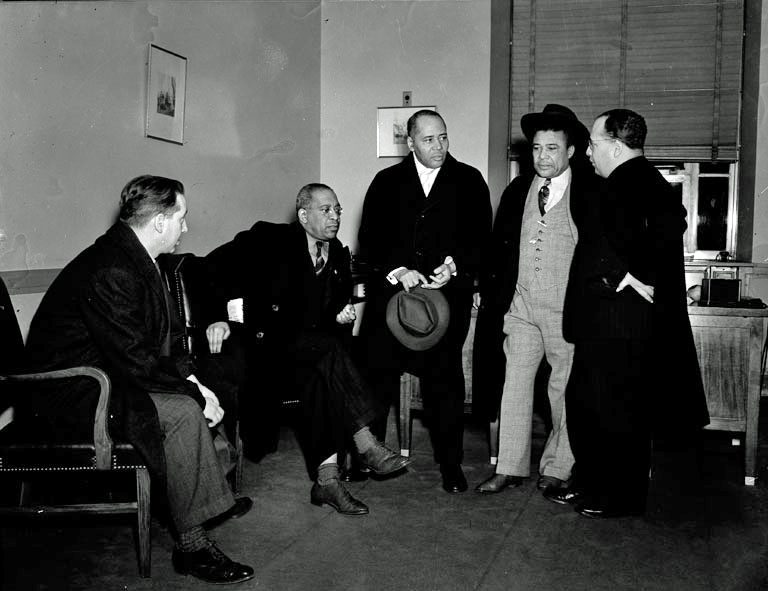
1940. Left to right: Louis Colman, William L. Patterson, Charles H. Houston, J. Finley Wilson, and John P. Davis. Patterson, Houston, and Wilson played prominent roles during the campaign during the 1930s to free the “Scottsboro Boys,” nine African American youths jailed in Alabama, eight of whom were sentenced to death. Photo by Scurlock Studio, courtesy of the Archives Center, National Museum American History.
In the southern United States of the 1930s and 1940s, a rigid racial caste system known as Jim Crow governed nearly every aspect of life. Laws enforced segregation in education, employment, housing, voting, jury service, public accommodations, and transportation. Police power, vigilante violence, and lynching operated together to maintain racial hierarchy where law alone proved insufficient. Northern cities, though often thought of as more progressive, maintained their own systems of racial restriction through housing covenants, discriminatory lending practices, occupational exclusion, unequal municipal services, and limited access to public accommodations.[13] At the federal level, Black citizens faced hostility or indifference from all three branches of government, including a Congress whose Southern members routinely blocked civil rights initiatives. See Id.
Within this landscape, Houston developed what scholars have described as a “well-conceived and well-executed plan of preparation and litigation,” focused on six interrelated areas of discrimination. Id. Education, however, stood at the center of his strategy. Houston recognized schooling as the gateway to professional opportunity, political participation, and social mobility. His attack on educational segregation became the crown jewel of his legal campaign. Id.
Houston struck first at segregation, where it would be most offensive to well-educated judges (in graduate and professional schools) and then ratcheted backward toward his ultimate target: segregation in primary and secondary education nationwide.[14] Through cases such as Pearson v. Murray (1936) and Missouri ex rel. Gaines v. Canada (1938), Houston forced courts to confront the constitutional absurdity of “separate” professional education.[15] Subsequent victories in Sipuel v. Oklahoma State Regents (1948), McLaurin v. Oklahoma State Regents (1950), and Sweatt v. Painter (1950) further dismantled the legal framework of segregation in higher education. Id.
Houston’s influence extended beyond education. In Shelley v. Kraemer (1948) and its companion cases, he successfully argued that judicial enforcement of racially restrictive housing covenants constituted unconstitutional state action, striking at one of the most pervasive mechanisms of residential segregation. Id. Even after his death, the lawyers Houston trained—the social engineers he shaped—carried his strategy forward, culminating in Brown v. Board of Education and reshaping constitutional law for generations. Id.
Worn down by decades of relentless advocacy, Houston suffered a heart attack in late 1949 and died on April 22, 1950. Id. at 24. On his deathbed, he wrote a message to his infant son to be read years later: “Tell Bo I did not run out on him but went down fighting that he might have better and broader opportunities than I had without prejudice or bias operating against him, and in any fight some fall.” Id. These words perfectly capture Houston’s legacy. He did not live to see the final victories his strategy made possible. But he went down fighting—having sparked the minds, built the method, and engineered the path by which the law itself could be made to yield justice.
[1]Roger A. Fairfax, Jr., Wielding the Double-Edged Sword: Charles Hamilton Houston and Judicial Activism in the Age of Legal Realism, 14 Harv. BlackLetter L.J. 17, 28 (1998).
[2] https://americanhistory.si.edu/brown/history/3-organized/charles-houston.html
[3] https://www.britannica.com/biography/Charles-Hamilton-Houston
[4] https://web.archive.org/web/20150905080154/http://www.law.howard.edu/1397
[5] Roger A. Fairfax, Jr., Wielding the Double-Edged Sword: Charles Hamilton Houston and Judicial Activism in the Age of Legal Realism, 14 Harv. BlackLetter L.J. 17, 22 (1998).
[6] See Genna Rae McNeil, Groundwork: Charles Hamilton Houston and the Struggle for Civil Rights 84–85 (1983)
[7] Roger A. Fairfax, Jr., Wielding the Double-Edged Sword: Charles Hamilton Houston and Judicial Activism in the Age of Legal Realism, 14 Harv. BlackLetter L.J. 17, 22 (1998).
[8] See Morton J. Horwitz, The Jurisprudence of Brown and the Dilemmas of Liberalism, 14 Harv. C.R.-C.L. L. Rev. 599, 600 (1979)
[9] William Bradford Reynolds, Another View: Our Magnificent Constitution, 40 Vand. L. Rev. 1343, 1348 (1987).
[10] Roger A. Fairfax, Jr., Wielding the Double-Edged Sword: Charles Hamilton Houston and Judicial Activism in the Age of Legal Realism, 14 Harv. BlackLetter L.J. 17, 39 (1998)
[11] See Neil Duxbury, Faith in Reason: The Process Tradition in American Jurisprudence, 15 Cardozo L. Rev. 601, 677–78 (1993)
[12] Joan Roelofs, Judicial Activism as Social Engineering, in Supreme Court Activism and Restraint 254 (Stephen C. Halpern & Charles M. Lamb eds., 1982).
[13] Roger A. Fairfax, Jr., Wielding the Double-Edged Sword: Charles Hamilton Houston and Judicial Activism in the Age of Legal Realism, 14 Harv. BlackLetter L.J. 17, 36 (1998).
[14] See Ken Gormley, A Mentor’s Legacy: Charles Hamilton Houston, Thurgood Marshall and the Civil Rights Movement, 78 A.B.A. J. 63, 65 (1992).
[15] Roger A. Fairfax, Jr., Wielding the Double-Edged Sword: Charles Hamilton Houston and Judicial Activism in the Age of Legal Realism, 14 Harv. BlackLetter L.J. 17, 41-42 (1998).
ABOUT THE AUTHOR
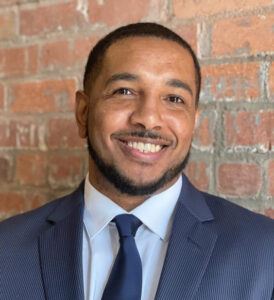
Crist Whitney is an Attorney at Rathod | Mohamedbhai LLC and the 2025 Sam Cary Bar Association President. As a Civil Rights attorney, Crist is a passionate representative for those who are less affluent and underrepresented. Crist advocates for the rights of the individual against governmental abuses and to serve the overarching goal of empowering the oppressed. Crist has written and published two novels: The Mile Highness, a study of hip-hop culture, and Battle for Supremacy, which examines politics, Black identity, the justice system, and the history and symbolism of race in America.